

© INQUIMUS
In early December 2025, the TiCCA4DANU – Transformative Innovation for Climate Change Adaptation in the Danube Region project took part in the INQUIMUS 2025 Interactive Conference on “Centering Justice in Climate Risk Management for Transformative Change”, hosted by the International Institute for Applied Systems Analysis (IIASA).
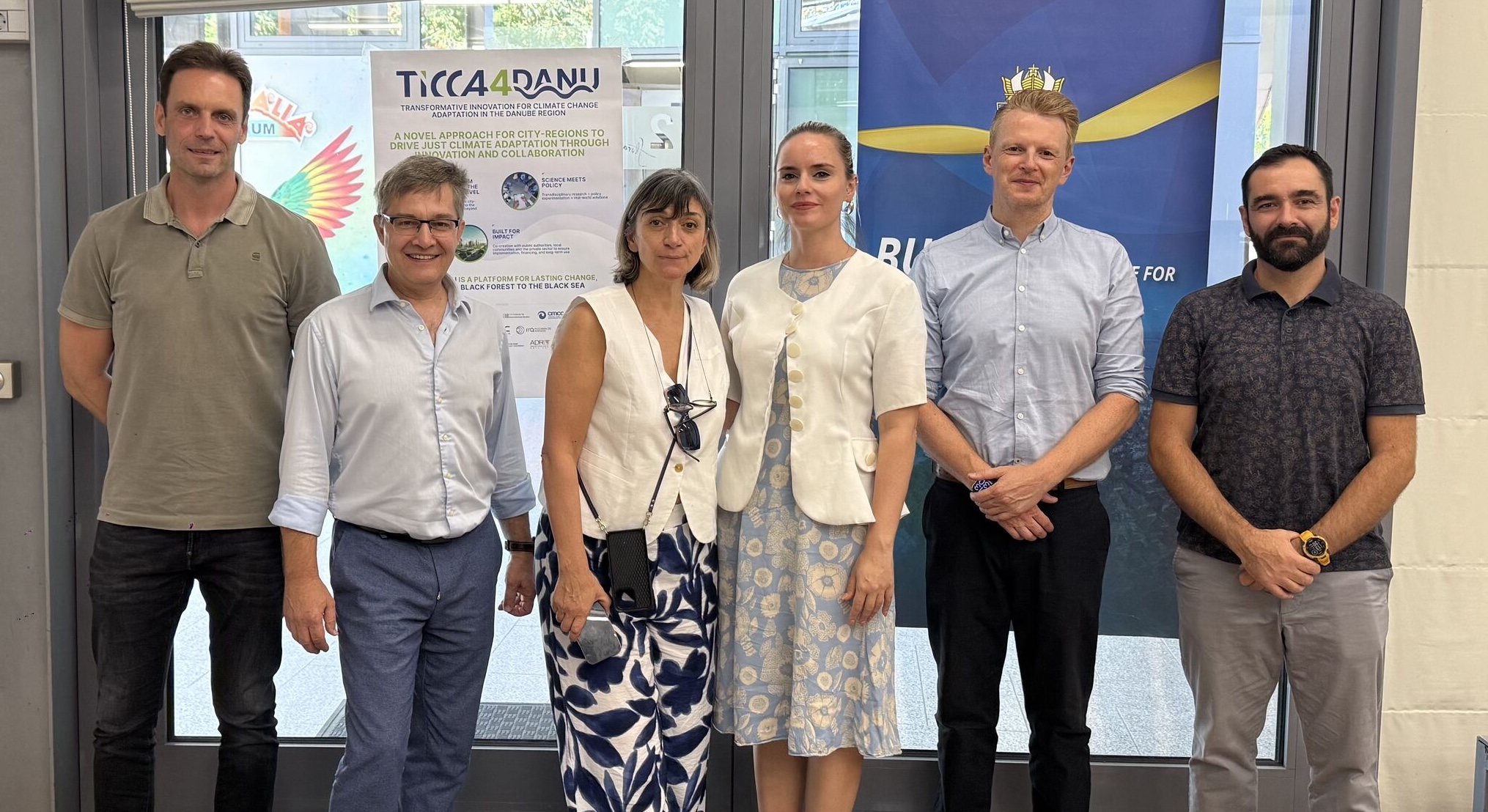
The conference brought together researchers, policy advisors, and practitioners to examine how justice can be more systematically embedded in climate risk management and adaptation processes. TiCCA4DANU was represented by project partners Elliott Woodhouse (IIASA) and Juliane Friedrich (University of Vienna).
Justice as a core element of climate adaptation
A central message of the INQUIMUS conference was that climate risks and adaptation measures are deeply shaped by social, institutional, and political contexts. Without an explicit focus on justice, adaptation initiatives may unintentionally reinforce existing inequalities or result in maladaptation, increasing vulnerability rather than reducing it.
Throughout plenary sessions and interactive discussions, participants explored how justice considerations can move beyond abstract principles and be translated into concrete planning and governance practices.
Key takeaways from the conference
Several insights strongly aligned with TiCCA4DANU’s objectives and approach:
Relevance for TiCCA4DANU and Local Green Deals
A key discussion at the conference focused on how justice can be made tangible and measurable so that it can be effectively integrated into adaptation processes. This question is central to TiCCA4DANU’s work across its Danube Region case studies.
Within the project, multiple dimensions of justice are being embedded into participatory adaptation workshops and the co-creation of Local Green Deals (LGDs). Through this approach, TiCCA4DANU aims to support climate adaptation pathways that are not only technically sound, but also socially inclusive and context-sensitive.
This work is being carried out in close collaboration with project partners ICLEI Europe, INFRAS, and VDI/VDE-IT, linking research insights with practical tools for local and regional action.
Looking ahead
Participation in INQUIMUS 2025 provided valuable inspiration and reflection for TiCCA4DANU’s ongoing activities. The conference reinforced the importance of centering justice as a foundational element of transformative climate adaptation and will inform the project’s future work on Local Green Deals and stakeholder engagement across the Danube Region.
TiCCA4DANU warmly thanks IIASA’s Equity and Justice (EQU) Research Group for hosting this timely and inspiring event.


© TICCA4DANU
More information about the conference is available on the official INQUIMUS 2025 event page hosted by IIASA.