
© TiCCA4DANU
How can cities and regions move from climate strategies to real implementation? This question is at the centre of TiCCA4DANU’s work on Local Green Deals and transformative climate adaptation across the Danube Region.
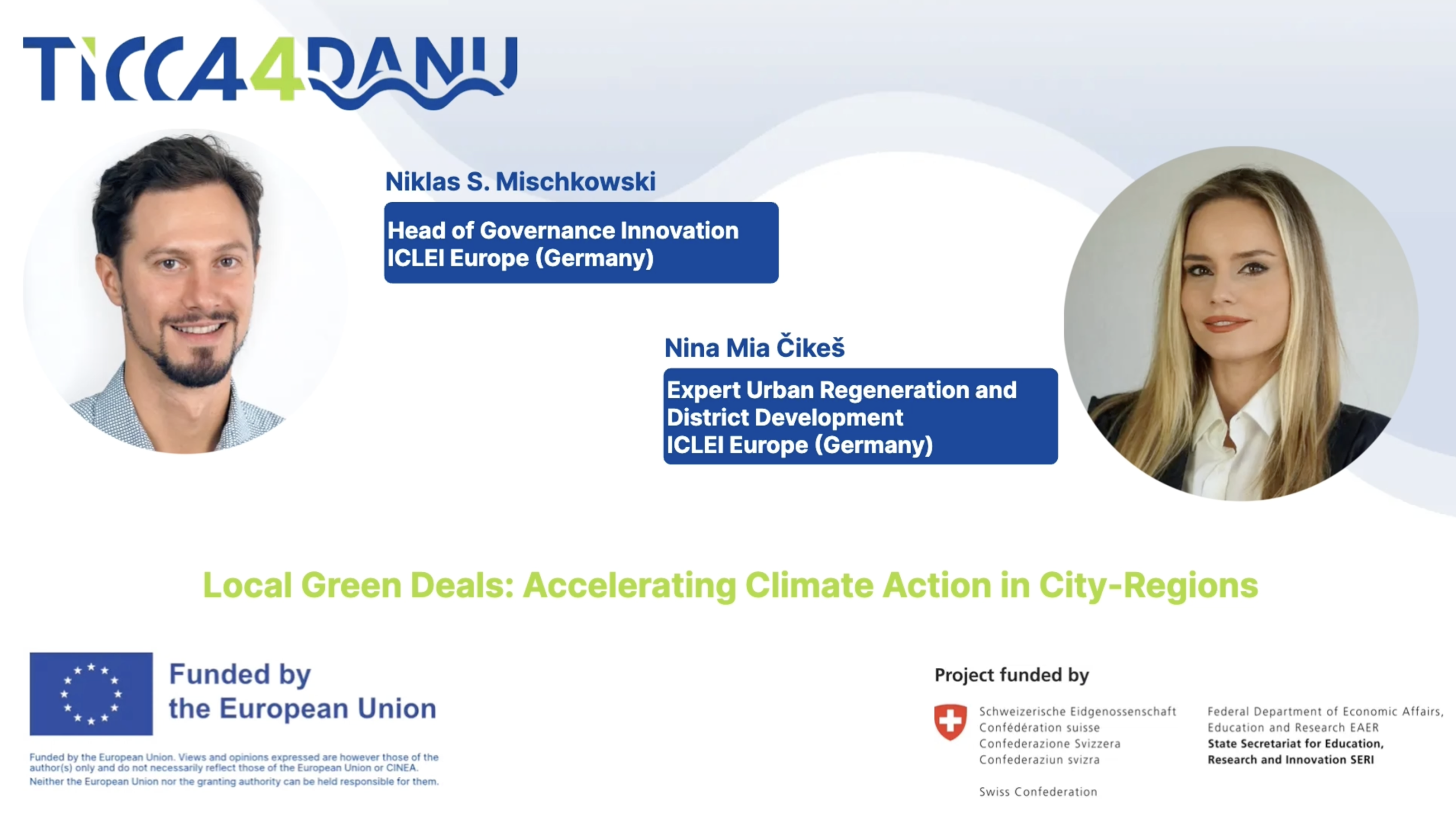
In a new TiCCA4DANU interview, Niklas S. Mischkowski, Head of Governance Innovation at ICLEI Europe, and Nina Mia Čikeš, Expert for Urban Regeneration and District Development at ICLEI Europe, explain how Local Green Deals can support cities, regions, companies, and local stakeholders in turning climate ambitions into concrete action.
Local Green Deals are governance instruments developed in response to the European Green Deal. They help cities bring together different actors and define clear responsibilities, concrete actions, timelines, and financing pathways. Instead of remaining general commitments, Local Green Deals are designed to support practical implementation across key transition areas such as energy, mobility, food systems, urban development, and climate adaptation.
A key message shared by Niklas S. Mischkowski and Nina Mia Čikeš is that Local Green Deals are not only agreements, but also a movement and an accelerator for implementation. By creating structured cooperation between local governments, companies, public institutions, and other stakeholders, they can help ensure that climate and sustainability measures are clearly defined and followed by real action.
Within TiCCA4DANU, this approach is being further developed in relation to city-regions and regional governance. While Local Green Deals have often been applied at the city level, climate adaptation frequently requires action beyond municipal boundaries. Natural ecosystems, climate risks, and adaptation measures often function at a wider territorial scale, making regional coordination essential.
The interview highlights that scaling Local Green Deals from cities to regions does not necessarily require a completely new model, but it does require stronger coordination, mutual understanding, and attention to the political and institutional realities of each region. This is particularly relevant in the Danube Region, where diverse cities and regions face different climate challenges but can benefit from shared learning and cooperation.
TiCCA4DANU also connects the Local Green Deal approach with the Open Discovery Process, a participatory method used in the project to identify needs, opportunities, and concrete adaptation measures together with local and regional stakeholders. By linking these methods, the project aims to support the development of actionable climate adaptation pathways that can move quickly from planning to implementation.
Through this work, TiCCA4DANU contributes to accelerating climate adaptation in city-regions across the Danube Region. The project supports local and regional actors in co-creating practical solutions, strengthening cooperation, and building more resilient communities for the future.
TiCCA4DANU – Transformative Innovation for Climate Change Adaptation in the Danube Region – is a Horizon Europe project supporting transformative innovation and place-based climate adaptation across the Danube Region.