
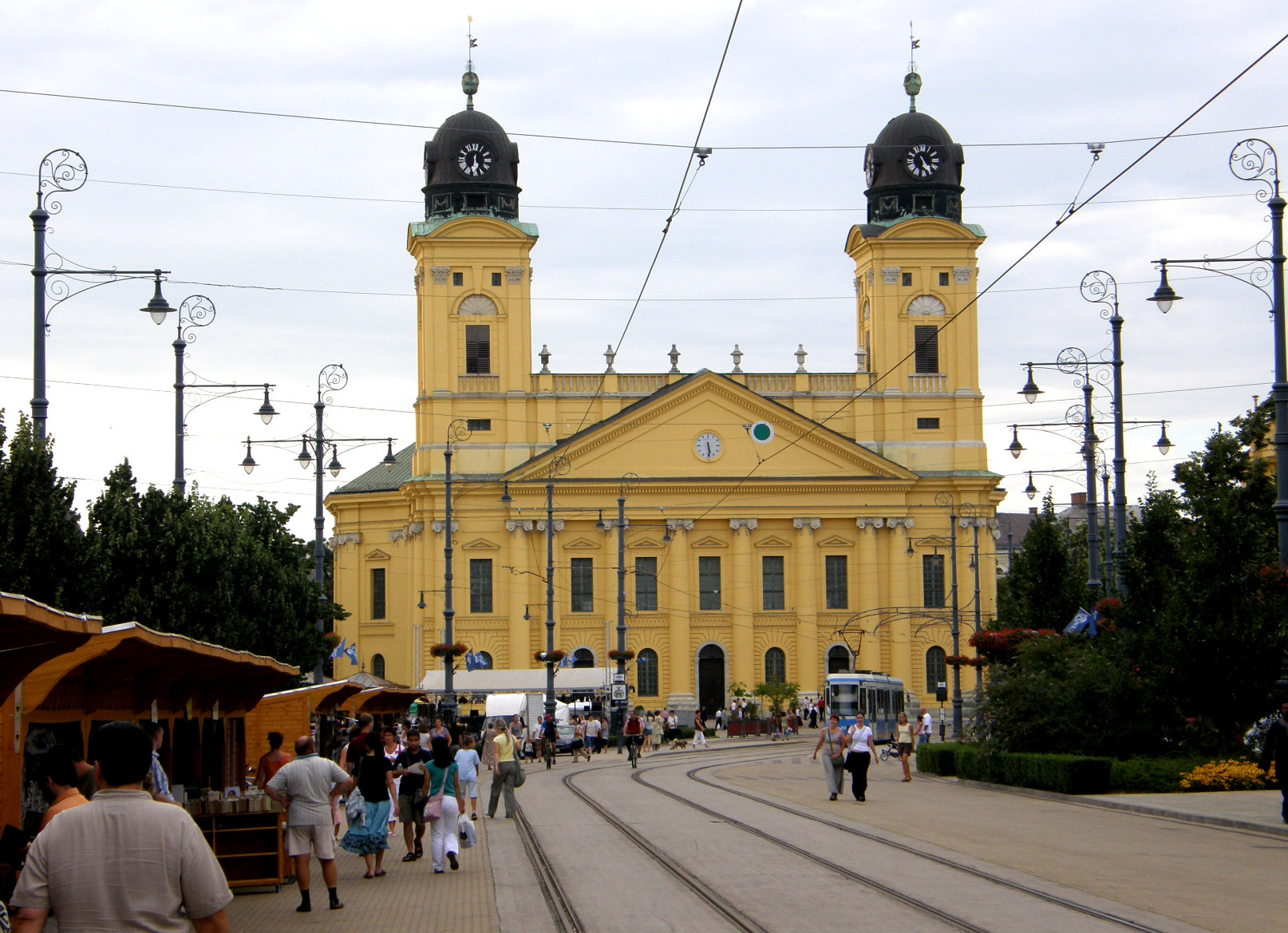
Credit: Nikl Gábor, CC BY-SA 3.0 https://creativecommons.org/licenses/by-sa/3.0, via Wikimedia Commons
Debrecen, Hungary’s second largest city with over 208,000 inhabitants, is the administrative and economic center of Hajdú Bihar County, located in the Great Hungarian Plain (Integrated Action Plan Debrecen, 2022). The city’s economy is supported by strong research and innovation capacities, closely linked to one of the country’s largest universities, the University of Debrecen (Interim Regional Report RIS4DANU, 2023).
While Debrecen is experiencing an upward trend in regional economic development, intraregional disparities persist between central and peripheral settlements in Hajdú-Bihar (Hajdú-Bihar County Climate Strategy, 2018). The districts outside of Debrecen are rural areas with strong reliance on agricultural production. Next to the agricultural sector, tourism is an important industry, both for Debrecen as well as some parts of the wider region. Notably, Hortobágy National Park, a UNESCO World Heritage Site and the largest natural grassland in Europe, is an important ecological habitat and tourist destination (UNESCO, 2024).
Debrecen and Hajdú-Bihar County face increasing challenges due to climate change, and both the agricultural and tourism sectors are affected by these risks. Average temperatures in the region are projected to rise more than the national average, with the number of hot days expected to increase by up to 90% by 2050 (SECAP). This trend poses health and economic risks, particularly in urban areas, where the Urban Heat Island effect increases heat stress. Moreover, other climate-related challenges in Hajdú-Bihar are closely tied to water extremes: scarcity and excess both occur, either leading to drought or floodings that threaten agricultural activities, infrastructure and natural ecosystems (Introduction to Hajdú-Bihar County, 2021).
Debrecen has started to address these challenges through a mix of strategic and practical policy measures. The Sustainable Energy and Climate Plan (SECAP) provides a strategic framework, while concrete initiatives, like the LIFE COOL ZONE project or the creation of an eco-park along the Tócó Canal expand green spaces and introduce nature-based solutions in urban areas. On a smaller-scale, also actions such as the free distribution of rainwater barrels support adaptation efforts and raise awareness.
Despite these steps, many challenges remain. Coordination and cooperation between municipal departments and with the private sector in Hajdú-Bihar County are often weak, and although broader national strategic plans exist, their implementation at the local level is inconsistent (Interim Regional Report RIS4DANU, 2023).
The TiCCA4DANU project addresses this gap through a “city-region” approach, promoting transformative innovation for climate change adaptation across Debrecen and Hajdú-Bihar County and strengthening collaboration among stakeholders from industry, academia, civil society, and the public sector.