
The EU Framework for Climate Resilience: Why We Shouldn't Start from Scratch
© Background by Kristian Aleksandrov; Photo: iit, ICLEI Europe
Europe's new Climate Resilience Framework offers an important opportunity to strengthen climate adaptation across the continent. But rather than creating new structures from scratch, the EU should build on the experience, partnerships and achievements of its existing Mission on Adaptation to Climate Change.
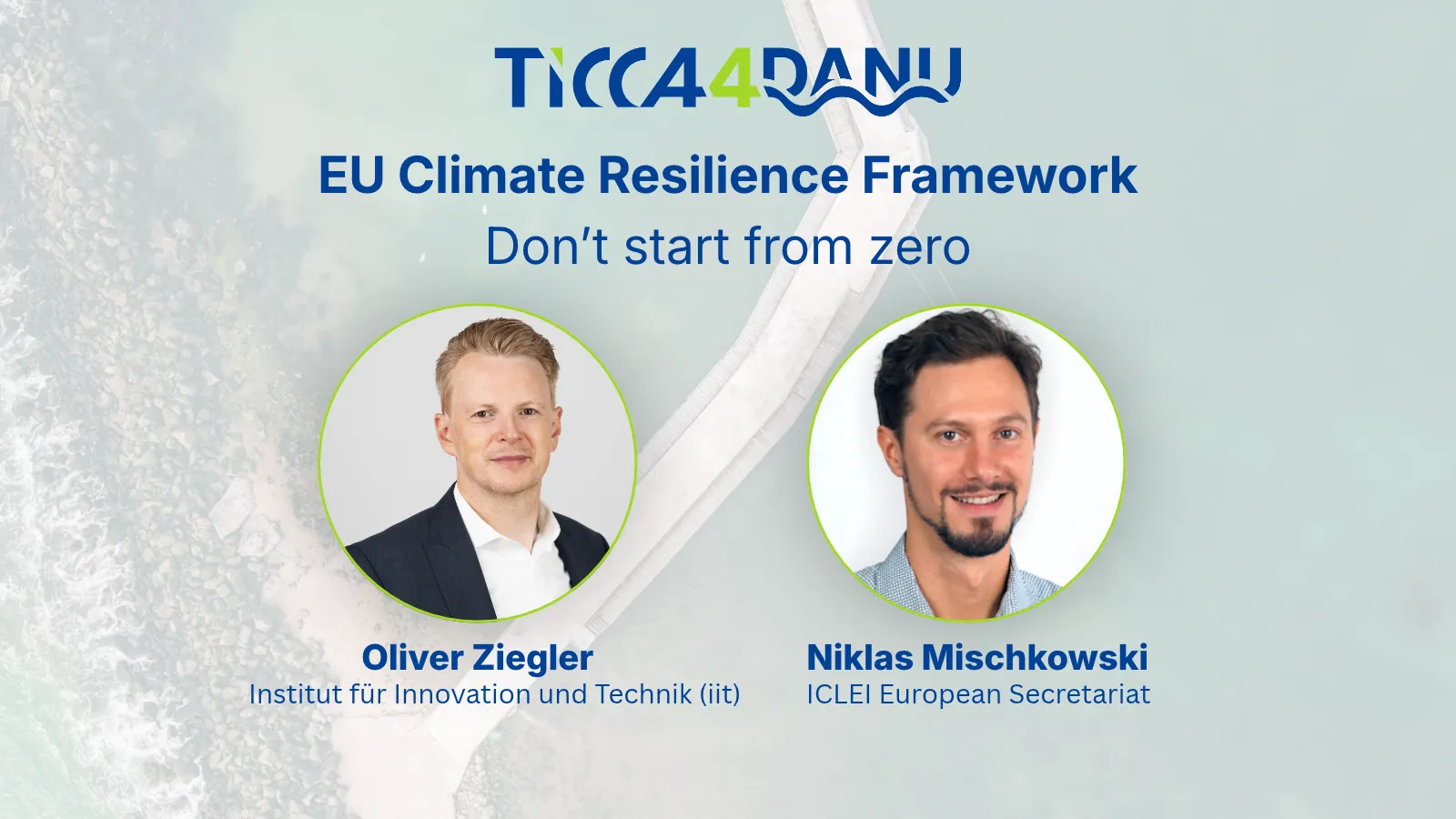
This is the central message of a recent opinion piece published in Tagesspiegel Background on 6 November 2026 by Dr. Oliver Ziegler, from the Institute for Innovation and Technology (iit) and coordinator of TiCCA4DANU, and Niklas Mischkowski, Head of Governance Innovation at ICLEI European Secretariat.
The European Commission's new Climate Resilience Framework, presented on 27 October 2026, aims to strengthen Europe's preparedness for growing climate risks through more systematic risk management, clearer responsibilities and better coordination across governance levels.
However, the authors point to an important contradiction: while the EU is developing a new framework, the future of its Mission on Adaptation to Climate Change remains uncertain.
Since 2021, the Mission has mobilised more than 600 regions and local authorities, supported the development of climate adaptation strategies and established valuable networks connecting research, policy and local implementation. Losing these structures would risk undermining years of progress.
From European Ambition to Local Impact
The authors argue that the new framework should build on these achievements, focusing on three priorities:
- Continuing the EU Mission on Adaptation to Climate Change until at least 2030, safeguarding existing partnerships and expertise.
- Measuring real impact, including reduced climate risks, stronger institutional capacities and mobilised investment, rather than simply counting activities.
- Connecting research and innovation with implementation funding, strengthening links between European, national and regional programmes.
TiCCA4DANU: Turning Climate Adaptation into Action
These recommendations resonate strongly with the ambitions of TiCCA4DANU. Working with city-regions across the Danube Region, TiCCA4DANU explores how transformative innovation policies, new governance approaches and collaboration between public authorities, businesses, researchers and communities can accelerate climate adaptation.
Europe's climate resilience will ultimately be built locally. The challenge now is to strengthen and scale what already works.
Read the full opinion piece (in German): Klimaresilienzrahmen: Nicht bei Null anfangen – Tagesspiegel Background, 6 November 2026