
© TiCCA4DANU
How can climate adaptation move from understanding risks to creating lasting change on the ground? A new TiCCA4DANU interim report on the Podravje Region in Slovenia combines climate-risk analysis with socio-economic, governance, justice and innovation perspectives. Its key message is clear: effective adaptation requires more than individual technical measures. It depends on coordinated action, local capacity, inclusive governance and long-term investment.
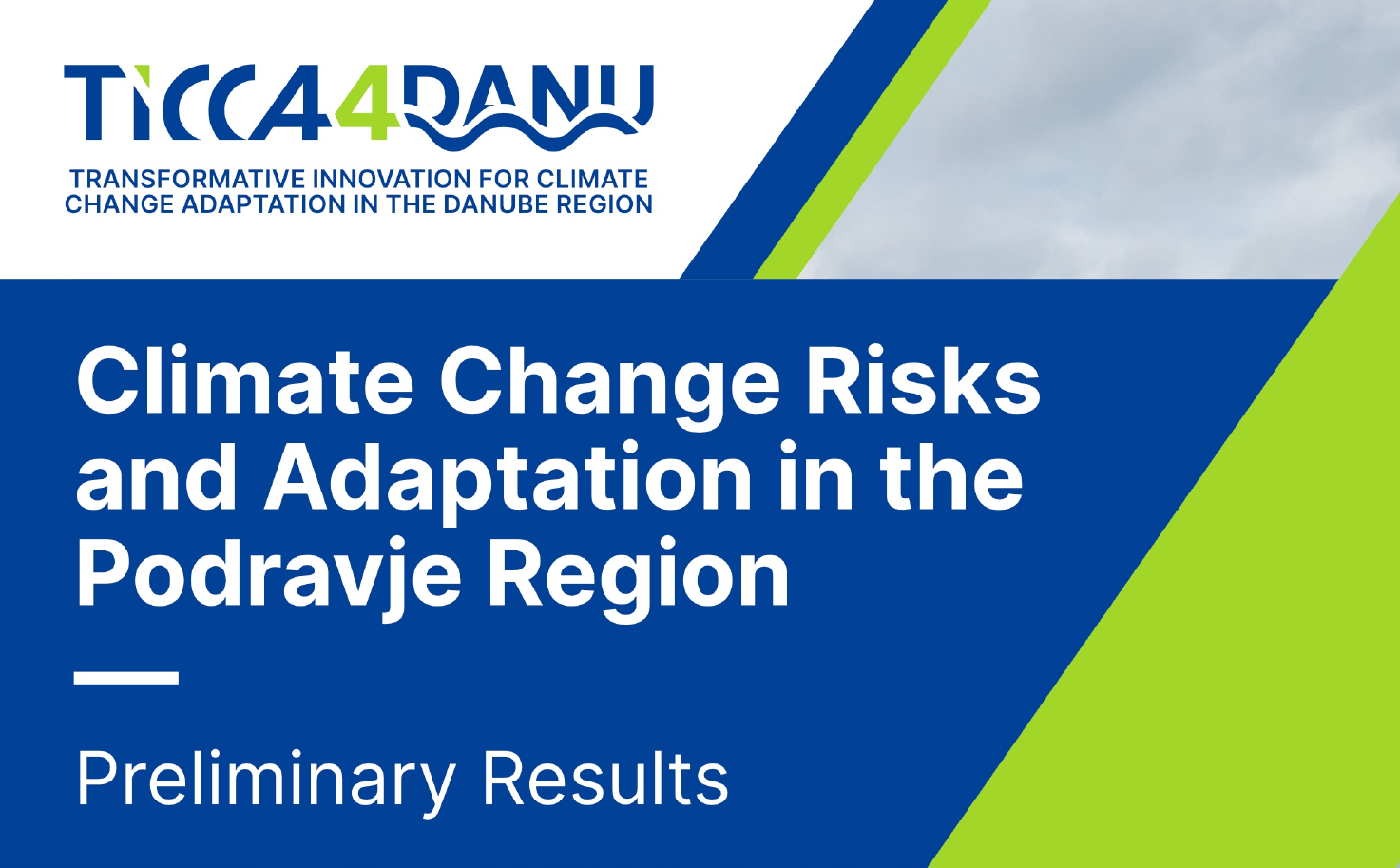
The report Climate Change Risks and Adaptation in the Podravje Region – Preliminary Results presents the current status of TiCCA4DANU research in the region. The findings are preliminary and will be further refined for the final report.
Climate risks are already visible
Podravje faces multiple and overlapping climate pressures, including extreme heat, flooding, drought and landslides. These risks are not evenly distributed across the region.
Extreme heat is particularly widespread. Around 91.5% of Podravje’s population lived in areas experiencing more than 30 tropical nights per year during 2016–2025. Flood risk is more spatially concentrated, with around 11,224 residents in 167 settlements exposed to a one-in-100-year river flood. Drought exposure varies strongly across municipalities and agricultural land uses, while a significant share of the road network lies in areas susceptible to landslides. These differences show why adaptation measures need to reflect local conditions rather than follow a one-size-fits-all approach.
Adaptation is also a governance and capacity challenge
Municipalities are central to implementing climate adaptation, but their capacities differ considerably. Many smaller municipalities face limited staff, expertise and access to funding. At the same time, regional coordination remains fragmented. The report therefore highlights the need for stronger inter-municipal cooperation, clearer coordination across governance levels, capacity building and more durable financing.
Adaptation should also become part of everyday municipal decision-making — from spatial planning and infrastructure to public-space management — rather than remain confined to individual projects or climate departments.
Innovation means more than technology
An important finding is that innovation for climate adaptation is understood broadly in Podravje. It includes not only technology, but also institutional and organisational change, cross-sectoral cooperation and new governance approaches.
Nature-based solutions such as greening and depaving are among the most visible practical innovations, while technological and market-led solutions are seen as useful complements.
From evidence to action
The report does not propose a fixed adaptation plan. Instead, it provides an evidence base for the next phase of co-creation with regional stakeholders.
Key strategic directions include tailoring adaptation to local risk and vulnerability, integrating resilience into municipal decision-making, strengthening cooperation, mobilising innovation capacities and creating more accessible and long-term financing arrangements. Adaptation should also be connected with mitigation, social justice and broader regional development.
For TiCCA4DANU, this is the crucial next step: bringing scientific evidence together with local knowledge and stakeholder priorities to develop adaptation pathways that are practical, inclusive and capable of evolving over time.
👉🏻 Read the whole report: https://ticca4danu.eu/wp-content/uploads/2026/10/TiCCA4DANU-Workshop-Input-Podravje.pdf